
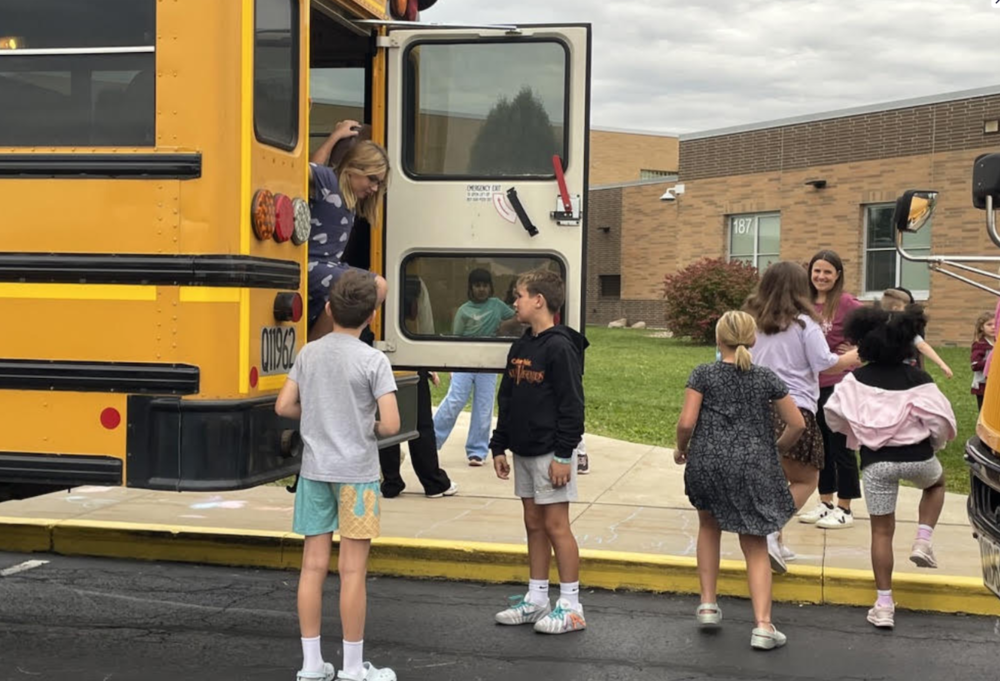
Streetsboro City Schools students put school bus safety into practice on October 1 during the district’s annual bus evacuation drills. The drills gave students who regularly ride a school bus an opportunity to learn and practice what to do if an emergency requires them to evacuate. Drivers reviewed emergency procedures, identified the bus’s emergency exits and, when appropriate, gave students an opportunity to practice using them.
“Students need to know what to do before they ever find themselves in an emergency situation,” said Transportation Director Amanda Hall, Streetsboro City Schools. “You react more quickly and effectively when you’ve already visualized or physically practiced something. They won’t have to wonder how to react because they already know what to do.”
During the drills, drivers explained three primary evacuation methods. Depending on the situation, all students may exit through the front door, all may exit through the rear emergency door, or students may split between the front and rear exits.
Drivers also discussed situations that could require an evacuation, including a fire or accident, as well as emergencies such as severe weather. Students were reminded that the driver would determine whether an evacuation was necessary and which exit method should be used. Some drivers also explained how students could use the bus’s two-way radio to call for help if the driver were unable to do so.
Evacuation drills are conducted once each year, with all regular bus riders participating unless a student has a special circumstance. For Hall, the drills are one part of a much larger commitment to safety that bus drivers carry out every day.
“A bus driver’s whole job is safety,” said Hall. “From making sure students are seated properly to helping them board and exit the bus, everything they do is safety-related, whether students realize it or not.”
Students were reminded to remain seated while the bus is moving, avoid eating or drinking on the bus and keep noise levels low so the driver can concentrate on the road.
One important safety practice families may not recognize is the use of driver hand signals when students board the bus or cross the street. Before signaling a student, the driver completes a series of mirror checks and observes surrounding traffic to make sure it is safe to proceed.
Hall also encouraged families to reinforce safe habits at the bus stop. Students should be at their stop at least five minutes before the bus is scheduled to arrive, wait until the bus comes to a complete stop before approaching and watch for the driver’s signal before boarding or crossing the street. After getting off the bus, students should remain at their stop until the bus pulls away so the driver knows they are safely out of the danger zone.
The annual drills helped make those procedures familiar so students and drivers are prepared to respond safely should an emergency occur.